Doris, Tony, and Blake are the organizers for this year’s NAISys conference, From Neuroscience to Artificially Intelligent Systems (NAISys), at Cold Spring Harbor. We discuss the conference itself, some history of the neuroscience and AI interface, their current research interests, and a handful of topics around evolution, innateness, development, learning, and the current and future prospects for using neuroscience to inspire new ideas in artificial intelligence.
Robin and I discuss many of the ideas in his book The Self-Assembling Brain: How Neural Networks Grow Smarter. The premise is that our DNA encodes an algorithmic growth process that unfolds information via time and energy, resulting in a connected neural network (our brains!) imbued with vast amounts of information from the “start”. This contrasts with modern deep learning networks, which start with minimal initial information in their connectivity, and instead rely almost solely on learning to gain their function. Robin suggests we won’t be able to create anything with close to human-like intelligence unless we build in an algorithmic growth process and an evolutionary selection process to create artificial networks.
Irina is a faculty member at MILA-Quebec AI Institute and a professor at Université de Montréal. She has worked from both ends of the neuroscience/AI interface, using AI for neuroscience applications, and using neural principles to help improve AI. We discuss her work on biologically-plausible alternatives to back-propagation, using “auxiliary variables” in addition to the normal connection weight updates. We also discuss the world of lifelong learning, which seeks to train networks in an online manner to improve on any tasks as they are introduced. Catastrophic forgetting is an obstacle in modern deep learning, where a network forgets old tasks when it is trained on new tasks. Lifelong learning strategies, like continual learning, transfer learning, and meta-learning seek to overcome catastrophic forgetting, and we talk about some of the inspirations from neuroscience being used to help lifelong learning in networks.
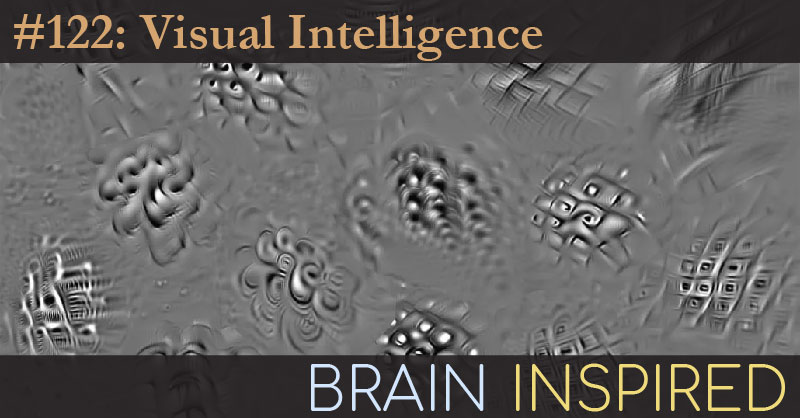
Ko and I discuss a range of topics around his work to understand our visual intelligence. Ko was a postdoc in Jim Dicarlo’s lab, where he helped develop the convolutional neural network models that have become the standard for explaining core object recognition. He is starting his own lab at York University, where he will continue to expand and refine the models, adding important biological details and incorporating models for brain areas outside the ventral visual stream. He will also continue recording neural activity, and performing perturbation studies to better understand the networks involved in our visual cognition.
Mac and I discuss his systems level approach to understanding brains, and his theoretical work suggesting important roles for the thalamus, basal ganglia, and cerebellum, shifting the dynamical landscape of brain function within varying behavioral contexts. We also discuss his recent interest in the ascending arousal system and neuromodulators. Mac thinks the neocortex has been the sole focus of too much neuroscience research, and that the subcortical brain regions and circuits have a much larger role underlying our intelligence.